top of page
  • Oct 16, 2019
  • 2 min read

by Olivia Clark


As the daylight shortens, I say my goodbyes to the color that fills the most joyous and memorable moments in my life - green.


The hue enters the Midwest’s landscape beginning in April with the first pasque flower on a warm, southern facing slope. The arrival of the season’s purples and light oranges are soon brought by bird’s foot violet and puccoons. Early spring emeralds emerge while the land around them is still asleep from the long winter, allowing them the attention of the awakening pollinators. To welcome these species into another year, one must expect an upward climb that will bring muddy boots and a feeling of new beginnings in the crisp spring air.
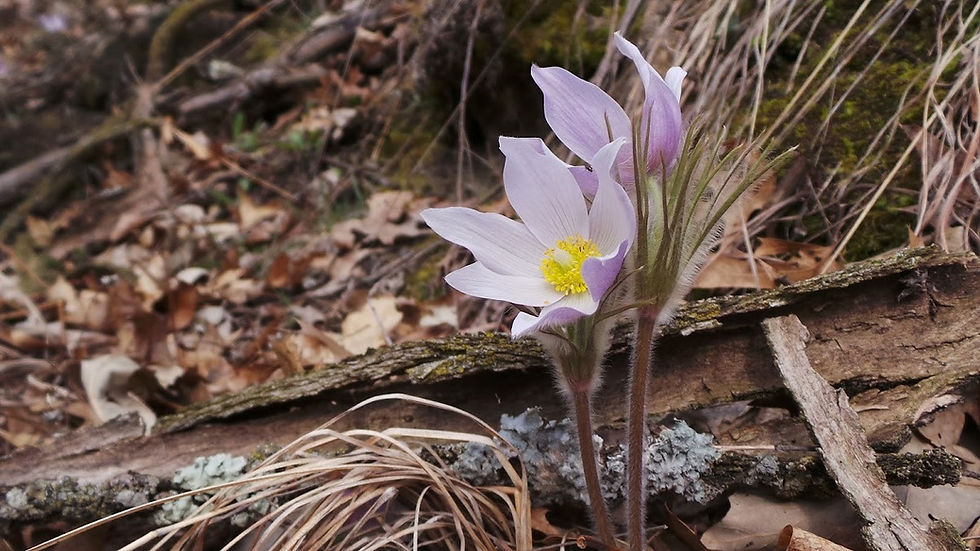


Pasque flower on a sandy slope just northeast of Madison, WI.


A few weeks later in a wooded area nearby, patches of wild geranium and Dutchman’s breeches flower under oaks budding out with new leaves. If you’re lucky, you may stumble upon a young fawn laying in a grouping of bedstraws.


The awakening green color is fully developed around June by the summer flowers eager to bloom. Fields of spiderwort and golden Alexanders buzz with the newly arrived pollinators. Each day, a seamless transformation occurs among the bloomers.

In the morning hours, heavy dew rests on the flowers that will leave your pant legs soaked in just a couple steps through the prairie. By mid-morning the dew is gone, and the flowers perk up at their peak bloom of the day. As the afternoon sun beats down on the prairie, many species start to close their petals to only be reopened the following morning.


The grasses take their turn at the end of July and reach heights near ten feet tall. Flowering plants become entangled in shoot systems of Indian grass and big blue stem. The density of the prairie has become challenging to navigate. The prairie has shifted to its greenest stage of organized chaos.


“Green chaos” with big bluestem on the prairie

Goldenrods are the first plants to bring autumn’s fields of gold, followed by the purples of the asters. The discontinuance of the production of chlorophyll in the prairie tells us that we have completed another year. The root systems that have grown larger are now storing energy for next spring as the shoot systems turn to seed and slowly decompose. The cool temperatures of autumn have arrived, and the prairie is now dormant. The green color that was once so abundant and alive, is now absent until spring.


I am a Biology major and Environmental Studies minor at the University of Wisconsin – La Crosse. I spend my summers restoring and researching prairies so much so that I have fallen in love with them. Each winter, I find myself cycling through last year’s plant photos and daydreaming that it was a warm May afternoon on the prairie.

Hours of plant classes, months of green-withdrawal and visits to Home Depot made me realize a monumental moment in my life: Why say goodbye to the many shades of green with winter approaching, when you can have house plants?


Plant lady Olivia with 30+ house plants she has acquired over the years.

Olivia is 21 years old and attends the University of Wisconsin - La Crosse. Follow Olivia's plant-y adventures on twitter and instagram.


  • Sep 25, 2019
  • 10 min read

by Riley Rackliffe


Riley and Fae

My fingers itched. My index finger was becoming raw from handling strands of lights as I worked them into the dense plastic needles of the growing forest in front of me. The small glass bulbs were hot, though not hot enough to burn in most cases. Sometimes I would lean my weight on one hand as I reached over the village and the pressure of my fleshy palm on the blazing bulb would feel an awful lot like burning. In all likelihood my hands were covered in small inflammations from countless encounters with little yellow flashes of light. Leaning back I felt the joints in my legs pop. Setting up the Christmas village was an intense act of focus for me. The first time it took me about a week. As I became more practiced in later years, I got it down to a solid nine hours. As an adult I could set the whole thing up in about five hours.


I started visiting Fae when I was 11. She must have been 77 that year, although I can’t remember her changing much over the years. She had asked my mother to come down because she wanted to hire a boy to help out in her large garden. She was thinking of my older brother but my mom knew better. She brought both of us down the street to her house. We walked around the yard and she talked about the help she needed. For $3 an hour I would be her weeder and help out with other odd jobs as needed.


Before her daughter Becky built her house next door, Fae’s yard covered about three acres. She had more bushes and strips of flower beds than anyone could reasonably handle alone. Between her being retired, me being homeschooled, the frequent visits of her son and daughter and grandkids, and the occasional heroic efforts of the local church congregation, we did a pretty decent job with the yard. Enough to host weddings now and then.


Mostly it just hosted Fae and me. I would pull weeds and plant flowers, trim bushes and rake leaves. Usually two or three times a week, after school. After a few hours and thoroughly mud-stained knees from kneeling in the flower beds she would invite me up to the house and give me some watermelon and maybe some nuts. I would sit on the back porch overlooking the garden and feel the wonder of stretching out my limbs again.


I could stare at that view forever. The yard, a domain I knew every inch of from the grasping memory of dirt-stained fingers searching for the roots of encroaching lawn, made up the foreground followed by the horse pasture. On the far side, a row of trees marked the edge of the hill where a canal was dug. This hill and trees perfectly shrouded the housing development at the bottom of the hill so the next visible thing was the golf course. This provided a large green landscape before blending into the traffic of the freeway, the city beyond, and a panoramic view of the Wasatch Mountains. I would stare at those mountains throughout high school as I planned which one to climb next and ponder the path one must take to reach each summit.


Fae and I would chat about things too. I think it worked because we were willing to listen to each other when few others would. She would talk about whatever had been on the news that day or how the city had grown so much since her father had built the house down the street. I would soak it all in and try to make sense of it all,occasionally offering my 2 cent conclusions which she often accepted. I suppose old women and young boys often have a hard time finding a considerate ear.

After some time she decided that I needed to learn to play the piano. She had been a teacher for many years, both a school teacher and a piano teacher. I had learned a few basics from my mother and watched my older siblings traverse piano lessons so I was amenable to the idea. After some watermelon she would march me to her baby grand piano and we would run through hymns and Christmas songs for an hour or so until I would go home. I don’t know how many years this lasted. I never did become a fantastic pianist but she always loved to hear me play when I would go back in later years.


When fall put a soggy cold stop to our outdoor yard work, she brought me inside the house to make up for the rainy days. We would clean cupboards one room at a time in her old three-story house. In reflection I don’t know how we made it last all winter but I would pull out the bucket of warm water and splash a capful of ammonia in it and scrub each shelf in each closet in each room. This of course required removing the strangest assortment of things she had collected over the years. She taught home economics, or interior design, or something like that at the Herriman High School. She had all kinds of leftover decorations. Flower mounting gear, candles, needlework, ceramics, dried flowers or seed pods from the garden, preserved fruit, and enough holiday decorations that we had to rotate which ones we used each year.


This is where the village came in. Years ago, beyond my memory, someone had given her a ceramic church that had a light bulb in it. Soon other small snowy buildings joined it and someone decided they should all be displayed together. A Christmas village was soon constructed with cotton batting as snow, little brick-styled rubber paths, and small glass people—the hand-painted kind you find in boutiques. This of course required some wire pine trees to add greenery and lights to bring a sparkle to the season. It was quite the undertaking. We would often spend the first day just sorting through the closets to find all the right boxes and try to figure out how many holes the cotton should have in it.


In the evenings, Fae would sit in her living room and look at the glowing village, She’d think up stories about the lives of the people in the small town - like the two girls carrying geese home from the market for their Christmas dinner. Or the girl by the lamppost reading a book who kept hoping the certain young man would stop and talk to her. Or the Santa Claus dressed man trudging through the snow with a heavy sack trying the reach the skaters zipping around the lake.


I don’t know if she actually dreamed of the stories or if she told them to me so that I would learn how to set everything in the proper place. “Attention to detail” was the key to the village. The woman carrying the packages had obviously already done her shopping and therefore must be on her way home, as opposed to the man with the briefcase who must be just starting his shopping. The deer would sneak down to the pond in the woods to watch the skaters there but never to the pond in the town where far too many people were about. I would point out the oddities of a village with only four houses also having four churches, or that the people on one end of town were three times larger than those on the other. What can you do when a village is built by years and years of grandchildren presents and doorstep donations?


I added my own pieces now and then (Fae had a birthday in November right before we started work on the village). There was a moose that made it in for a year or two but then was deemed too fragile for use (it’s also possible she forgot it was part of the village). A couple of deer with a “No Hunting” sign echoed my growing environmental sensitivities. I often would wrap her presents and hide them under her tree or on the doorstep so I could sneak away before she saw me. I hated to be there when she opened them for some reason, even though she almost universally appreciated them (a box of mints one year was passed on to others more interested in sweet things.)

She always insisted that “Good taste has no price tag,” as she had taught her students all those years. This encouraged me to devote creative energies into her presents instead of financial means (I never asked for a raise, so I continued to make $3 an hour right up until I left for college at 18.) She has a wooden clock I fashioned in my scroll saw phase, a wooden painted eagle, and a plaster cast of her dog Penny’s footprint.


I stepped back from it all when I went away to college. I would still wander down to visit when I was home now and then, although it became harder to ride my blue razor scooter down the street, as I grew too tall to reach the handles. I missed two years while I was living in California and shortly afterwards my parents moved away from our old house up the street to another several miles away. Even so, I would find myself, the day after Thanksgiving, starting to think about Christmas lights and snowy fake pine trees in a small glass town. Invariably I would take a day off to return to Fae’s house, dig out all the Christmas stuff from the basement and set up that village.


As I grew older, I began to doubt that the cotton was white enough anymore or that we had enough lights left working to make it worth it. But somehow it all came together. She would hover above and remind me where each house went, telling the stories of each person, although perhaps more to remind herself than to remind me. It did become harder for her to stand, so I stationed her on the couch where she was tasked to open and unwrap the adornments from their packaging. By the time it was all set up the small plastic deer and gently glowing lights made me see past the aging cotton and gradually slowing matron to a Christmas day in a small snowy town, trapped forever in time.


Sometime after Christmas day, and usually after New Year, I would return to pack it all up again. Somehow it always came apart faster than it would go up. I would line up all the glass figurines on the couch and she would wrap up each one while I rolled up the lights once again, in reverse order from how I set them up. Before we started, we would turn on the village one last time and gaze at it. She would say “I suppose we should take it down shouldn’t we,” as if asking me to convince her. So I would answer with the appropriate arguments about how it made Christmas special, and if we never took it down it would get dirty and so forth. She would agree and we would gaze a moment more and think about the holidays gone. It was the first step to looking forward to spring.


Fae grew things. Her house was always a collection of plants that she decided shouldn’t die in the snow that year. Again and again she told me about how growing things heals the weary soul.

She would give me articles now and then from her various magazines about all kinds of medical and psychological benefits to spending time in a garden. I would wash the dirt from my fingers and wonder what the arthritis would feel like from all the hours of weeding I did. Yet I loved it. As a result of her influence I planted a sunflower seed every day for a month to take up to scout camp for the summer when I taught the nature merit badge so I could show everyone what a growing plant looked like. Within 20 minutes of arriving, the voracious chipmunks had eaten every single seedling.

In college, I spent two months trying to get a tulip to bloom indoors in time for Valentine’s Day the same way she seemed to convince bulbs to flower in mid-December. Whenever I gave a girl flowers I couldn’t bring myself to pick them, so I gave her the whole pot with the flowers firmly rooted. I sprouted a pineapple plant from a store-bought fruit and for six years of schooling carried it from apartment to apartment each time I moved.


Fae worked hard to grow plants and she did it well. All those years teaching school she grew students. She raised her children, and many of her grandchildren. She helped teach the young people at church and gave us frequent opportunities to visit and help her. For some reason, after all she had done and all the years she had lived, she decided to grow one more boy. She could have used him as just another hired hand to help in the garden. She could have paid him and sent him home each afternoon and he would have been fine. But instead she became one of his best friends. A compassionate mentor in challenging times and an encouraging voice to do better when things got too easy.


The year she turned 93, I swung by after Thanksgiving ready to once more feel the itchy plastic of fake Christmas trees. Her tenants downstairs let me in and warned me that she couldn’t hear much anymore. I found her staring out the window and surprised as always by my visit. But this time she didn’t remember my name and couldn’t figure out why I had come. She couldn’t hear me well enough for me to explain. Soon Becky came from next door and explained how her mind had slipped in the last year, finally allowing age to claim its own.


We agreed that a little Christmas village may cause more harm than good by confusing her normal surroundings. This year the glass houses stayed in their boxes, the dust filtered deeper into the cotton. The timeless village isn’t gone, its inhabitants frozen forever as always. They remain a perpetual snapshot of the spirit of a season and a special woman, put once more away in storage with the promise of the coming spring when flowers will reawaken and the horses will graze across the pasture. And one particularly small boy with mud-stained jeans will follow an old woman around her garden.


Riley is 31 year old PhD student in aquatic ecology at Purdue University, IN. He still keeps house plants. Check out Riley’s blog at http://blog.riley.rackliffe.org/


Updated: Aug 29, 2019

by Dr. Lizz Waring


This story is the written form of Lizz's wonderful, engaging talk in the Plant Love Stories session at the 2019 Ecological Society of America annual meeting in Louisville, Kentucky earlier this month.


I’m Lizz Waring, and I am a botanist. Seriously, it’s my job to look at and teach others about plants. It’s amazing. And this may come as a shock to you, as I wasn’t always a botanist. 


I started out as a child who had no idea what they wanted to be when they grew up. When I was a kid all the way through graduate school, my fellow nature junkies would tell me about how much they loved nature documentaries, especially those narrated by that guy, Sir David Attenborough. 


Sir David Attenborough has written and hosted many nature documentaries. Image: https://www.bbc.com/news/entertainment-arts-45631267

But you see I was not. I have tried to love the nature documentary genre, but they were never my cup of tea. No, I am a pop culture junkie and have been since I was in grade school. But that doesn’t mean movies haven’t influenced my career. In fact, there are a number of movies that I can positively say made me the botanist I am today. Also, here is the spoiler alert: If you are mad about it, fight me about it on twitter later (@LizzWaring). 


First and foremost, picture it. The year: 1993. The season: Sometime in the summer. I was in elementary school. That was the summer maybe the most important movie of all time came out. No not Groundhog Day or Judge Dredd, although those are both good ones. I am talking about the greatest... 


The one and only: Jurassic Park


Dinosaurs! 


Mr DNA! 


Drama! 


Cool dinosaur puppets! 


You probably know this, but the gist of the movie is dinosaurs are cloned for an amusement park, dinosaurs get loose, chaos ensues. 


During her ESA talk, Lizz shared a photo from Jurassic Park, featuring the inspirational paleobotanist character, Dr. Ellie Sattler (Laura Dern) on the right. Photo by Caitlin McDonough MacKenzie.

To this day, this is one of my all-time favorites, and this is in no small part due to Laura Dern’s character, Ellie Sattler. You see, Dr. Ellie Sattler was the first time I was aware that you could study plants as a JOB. Like an honest-to-God job. She was invited to Jurassic Park as a paleobotanist, and she used her botanical knowledge to figure out why the Triceratops was sick! She knew about the toxic effects of the West Indian Lilac (Tetrazygia bicolor). 


In addition to being the world’s foremost dinosaur-poison-berry expert, Ellie Sattler was a total badass. She inserted feminism into Jeff Goldblum’s Dr. Ian Malcolm’s chaos theory, then saved him from a charging T-Rex. Oh and later she saved everyone by turning the power back on on the island by dropping into a Velociraptor pit. Lesson learned from Jurassic Park: Botanists are amazing and are constantly saving other scientists in one way or another.


FernGully: The Last Rainforest movie poster (20th Century Fox). Image: https://en.wikipedia.org/wiki/FernGully:_The_Last_Rainforest#/media/File:Ferngully.jpg

Another movie from my youth that had an impact was FernGully, which is a film about deforestation in the Australian rainforest. Told through a fairy, Crysta, who shrinks a lumberjack, Zak, together they fight a pollution-eating, forest-destroying, evil spirit named Hexxus--voiced by the great Tim Curry. Also, a genetically modified bat made kids aware of testing on animals. At the end of the film, Zak, the human, goes back to his lumberjack buddies with a single seed, and takes them on a walk to discuss changing their point of view on cutting down these trees. While this conclusion oversimplifies a very complex global issue, FernGully taught me that:1) plants are important, and 2) we need to talk about the importance of plants and global pollution with one another. 


Then I got older as we all do. At this point I knew getting a job was important. But that was it. I took a turn that many of us do and became invested in camp. Not the activity, the art form. The campier the movie the better. I want your John Waters, your bad musicals, and much like FernGully, literally anything starring Tim Curry. 


Actually, my love of camp probably started a bit before FernGully. Does anyone remember the movie, or the cartoon show, or the video game, Attack of the Killer Tomatoes? Anyone? The short version is tomatoes become sentient and rise up against humanity. I watched the cartoon as a kid, so the idea of plants attacking humans was in my head when I fell in love with the next movie, Little Shop of Horrors. A rocking musical about an alien plant that comes to earth, manipulates a simple flower shop worker into feeding him people and the love that flower shop worker has for a woman named Audrey. The murderous plant is Audrey II, named for our leading lady by Seymour. An orphan who wants love, but ends up a murderer--just a typical love story.


Audrey vs. Audrey (Ellen Greene) from Little Shop of Horrors (Warner Bros.) Image: https://www.nytimes.com/watching/titles/little-shop-of-horrors

It may sound silly, but Little Shop of Horrors truly has influenced me as a botanist. In the same way that Attack of the Killer Tomatoes influenced me. We need to respect our plants. You never know what may try to eat you or take over the planet. 


The film, Adaptation (Sony Pictures). If you haven't seen this, and you're reading this blog, there's a 99% chance you'll love this movie. Image: https://en.wikipedia.org/wiki/Adaptation_(film)#/media/File:Adaptation._film.jpg

I finished high school. (I still love campy movies, and if anyone wants to talk more about that find me or send me a tweet!) While in college I saw Adaptation, which is a movie about a writer writing a movie about a book about orchid thievery. Great movie. I’m actually not going to talk about the orchid thieving but rather the idea of writers’ block. Charlie Kaufman, the screenwriter of the film, and the main character, played by Nicholas Cage, is suffering from extreme writers’ block. Why? Writing is hard! It’s hard for everyone! It was certainly hard for me in college, and it’s still a struggle. While scientific and screenplay writing tackle different topics, the struggle is the same. 

The last movie I want to discuss came out more recently, The Martian. Matt Damon is a botanist astronaut! Which is cool. Who is accidentally left on Mars during a freak accident. Which is not cool. The movie portrays his struggle to stay alive. While living alone on a planet. Eating nothing but potatoes and having nothing but ABBA to listen to. I was well into my PhD studies when this movie came out. But it was still inspiring to have a botanist as the movie’s hero. More than 20 years after I was first enamored with the idea of studying plants as a job--thanks to Laura Dern as Dr Ellie Sattler in Jurassic Park--here I was a professional botanist getting excited in the movie theater all over again about being a cool, hero botanist. 


In The Martian (20th Century Fox), astronaut Mark Whitney (Matt Damon) has few options to survive, and realizes he's "going to have to science the sh-- out of this." So he grows potatoes and uses his "night soil" as fertilizer. Image: https://www.businessinsider.com/potatoes-mars-growth-cubesat-experiment-2017-3

To conclude, I would like to point out something else. There isn’t a whole lot of diversity in these botanist characters. Part of the mission of Plant Love Stories is to inspire plant appreciation in all people. On the off chance that anyone here is ever asked to consult on a movie or book or you write your own, please encourage diversity within the characters. Because we all have a plant love story to tell and representation matters.


Lizz Waring (@LizzWaring) is an assistant professor at Northeastern State University in Oklahoma. Carex is her favorite genus of plants.


bottom of page